
Sealantium Medical today announced the publication of its exploratory dura sealing study in the peer-reviewed International Journal of Toxicology. The study evaluated sFilm-FS™, Sealantium’s thin, transparent fibrin sealant patch, against TachoSil® in a rabbit dural defect model.
“Preventing CSF leaks remains a demanding priority in neurosurgery. Showing that sFilm-FS supports clean tissue bridging without inflammation—while preserving surgical visibility—is an encouraging step forward and addresses the key clinical needs highlighted by neurosurgeons in our interviews.”
Jack Spira, Medical Director, Sealantium Medical
The clinical problem: CSF leaks
Whenever the dura is opened during neurosurgery, it has to be closed again. If the closure is not watertight, cerebrospinal fluid (CSF) can leak. CSF leaks can lead to fluid collecting under the skin (pseudomeningocele), leakage through the wound, intracranial hypotension, meningitis and infection, and may require a lumbar drain or a second operation.
A 2022 systematic review found CSF leaks after 2.9% of supratentorial and 5.8% of infratentorial cranial procedures, and in around 6% of skull base procedures (Neurosurgical Review, 2022). Sutured closure remains the standard of care, with sealant patches used to reinforce it, but many current patches are thick, opaque sponges that hide the tissue underneath.
What neurosurgeons told us
Neurosurgeons we spoke with in Europe and Japan consistently underscored both the burden of CSF leaks and the surgical value of visibility and secure tissue adherence.
“If we do not close the dura mater well… the risk of complications, whether a fistula or an infection, is much greater.”
Neurosurgeon, Europe
“Serious CSF leaks occur in about 10% of the surgical procedures I deal with, and in that emergency situation sealants are necessary.”
Neurosurgeon, Italy
“Sometimes we have to lift the patch while suturing to be sure there is no underneath bleeding and no brain tissue has been caught in the suture.”
Neurosurgeon, Italy
“The products I use are sometimes stiff and do not adapt to the tissue, so cutting the right size is critical.”
Neurosurgeon, Italy
Anonymised quotes from Sealantium surgeon interviews, 2026. Some translated from Italian.
About sFilm-FS™
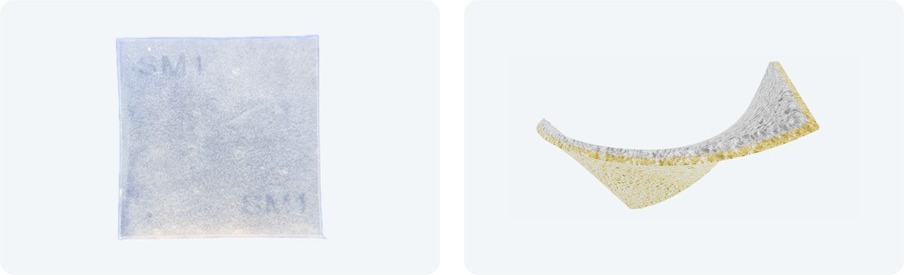
sFilm-FS™ is a flexible, bioabsorbable polymer film, 100–200 µm thick, carrying human fibrinogen and thrombin. On contact with moist tissue the fibrin components activate and the film adheres, providing immediate mechanical sealing and support. Once applied, the film becomes transparent, so the surgeon can see the tissue beneath it.
sFilm-FS™ is designed as one patch for bleeding control and tissue sealing across surgical specialties, from liver and cardiovascular surgery to GI and neurosurgery, and across open, laparoscopic and robotic procedures.
The study
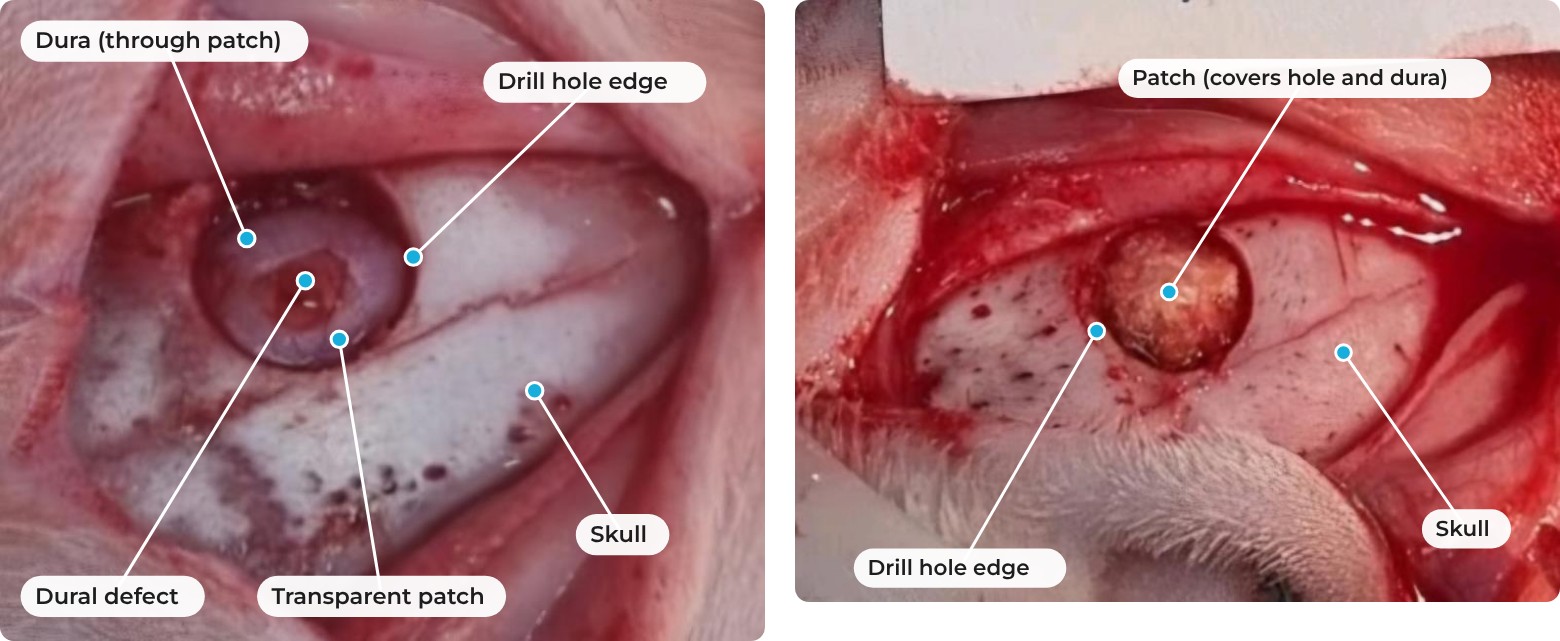
A standardized 8 mm cranial defect and 4 mm dural defect were created in rabbits and covered with either sFilm-FS™ or TachoSil®. The animals were followed for 4 weeks, and the local tissue response was assessed under the principles of the ISO 10993-6 standard for implanted medical devices.
Key findings at 4 weeks
- Intact patch optimally sealing the defect, with no inflammatory reaction (ISO 10993-6 grade: “no reaction”)
- Neo-dura formation: a continuous patch-tissue interface, with sealing tissue resembling native dura. TachoSil® had not formed a continuous bridge at the same time point
- Transparent on the dura: the surgeon can see the defect underneath
- No damage to the brain: underlying brain tissue intact on histology
Building on our liver surgery data
This publication adds to two earlier peer-reviewed publications on sFilm-FS™ in liver surgery: a Phase I/II randomised controlled trial against TachoSil® in the American Journal of Surgery (2025), and a preclinical safety and efficacy study in the Journal of Toxicologic Pathology (2021).
Our thanks to Dr Yuval Ramot, Dr Abraham Nyska, Dr Noam Kronfeld, Orgad Laub, Eran Cohen, Ilaria Brambilla and Chris Lamb for their work on this study.
About Sealantium Medical
Sealantium Medical is a biosurgery company focused on the development of proprietary next generation tissue sealants and hemostatic agents for patients undergoing surgery. sFilm-FS™ is an investigational product and is not approved for commercial use.